Sunday, March 31, 2013

Why MLB Opening Day is the Best in Sports


Baseball is all about tradition, and there's no better tradition than opening day.

Say the words "Opening Day" to anybody and they know right away that you're talking about baseball. For baseball fans, it's nothing short of a nation holiday. Whether your team last played in August or October, this is definitely the best kickoff event the sports world has to offer.

Now there is "Opening Night" which features the Houston Astros against the Texas Rangers. Even though the Astros are playing their first game in the AL, this still doesn't qualify as Opening Day. Opening Night is more of a media event. It's baseball's way to get one game on primetime Sunday Night television. The real magic happens the day after.

Some ballclubs raise banners on Opening Day, and others trot out stars from years past. A-list celebrities throw out the first pitch, and the pregame ceremony is the best all year. While all of these little nuances are nice and make the day just a little more entertaining, they're certainly not what makes the day special.

Hi-res-559908_crop_exact
Mark Lyons/Getty Images
Case in point: the Findlay Market Parade. It's been carried out every year for something like a million years in Cincinnati to celebrate the return of Reds baseball. It can be considered an annual reminder that the Reds have been playing America's pastime for longer than any other club in the major leagues.

It doesn't happen every year anymore, but the President of the United States throwing out a first pitch on Opening Day is a tradition that dates back more than 100 years. William Howard Taft got it started in 1910, and Barack Obama officially made it a 100-year tradition back in 2010.

The NFL will have an answer to this tradition when the president takes care of the first coin flip of the season. The NHL when the president drops the first puck. The NBA when the president tosses the ball up for the opening tipoff. Good luck with that, guys.

Opening Day is also at the perfect time. Spring is a time that everyone likes. Warm weather is on its way for most of the country, and it's the time period where is perfect weather in the southern part of the United States. There's no football, college basketball is drawing to a close, and the horribly long NBA season is still dragging on. It's the day of the season where anything is possible, even the Houston Astros selling out or even beating the Texas Rangers on national television.

Another great thing is the pitching matchups. Being named the opening day starter means a lot to most starters, and they don't take it lightly. Pitching in front of a packed house against the other team's number one starter can really get the blood pumping, which makes for awesome baseball.

I may be a little bias toward baseball since I play it and it's by far my favorite sport. But the excitement and feel inside the ballpark, along with the competitiveness in every single game rivals no other sport. The stats in spring training, good or bad, mean nothing once the real season starts. Whether you want to see an up and coming prospect that might want to lead your team to the promised land, or your amped up to watch the star players, nobody will be disappointed (unless your team loses.) Opening Day is an unofficial national holiday, so just kick back, relax, and enjoy everybody.

-Wyatt Smith, Sports Editor of Clickege Media

Saturday, March 30, 2013

Cinderella Story Comes to an End


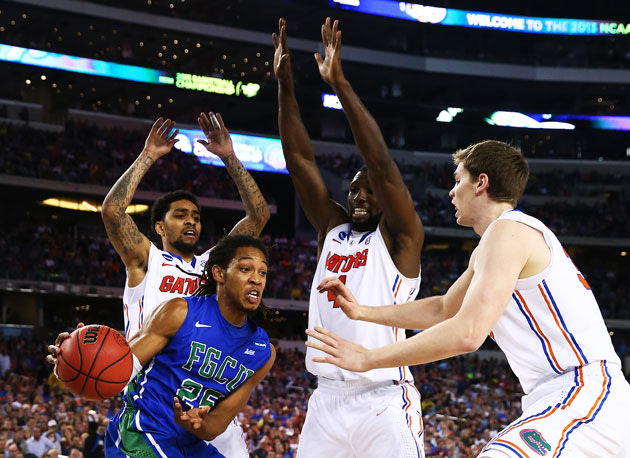
After becoming the first 15th seed to reach the Sweet 16 in NCAA tournament history, Florida Gulf Coast University lost to in-state rival Florida 62-50

Florida Gulf Coast University's Cinderella run ended the way most bad dates do: with anger, frustration, self-loathing and and a vow to never speak of this night again.

The Eagles jumped out to a 15-4 lead after a few trademark alley-oops and exciting fast break scores. But then Florida realized that they were a 3 seed that had gone to the Elite 8 the past two years and were facing a 15 seed. In light of this realization, Florida unfurled a 23-2 run and led 30-26 at halftime with FGCU already looking worn out.

The Eagles had as many turnovers (20) as field goals in the game. So even though they ended up shooting a higher percentage than the Gators, there wasn't enough opportunities to score. The philosophy of "lets throw a lob towards the basket every other possession and see what happens" turned out to fail against the more athletic and strong Florida team. The key moment came when Mike Rosario passed the inbound off of his defender on the sideline and took it all the way to the rim for a dunk with about two minutes left. A very fitting exclamation point to an overall sloppy and forgettable game for the Eagles.

But don't let this last game, as bad as it was, be the take away of the 2013 Florida Gulf Coast Eagles. They were the first 15th seed in history to go as far as they did, and they still kept up with powerhouse Florida in their loss. If asked what FGCU was before the season started, most people would say it was some DIII school or even an online type of college. But they brought their fun, cocky personalities to the big dance and outshined the likes of San Diego State and Georgetown. This team in the reason that the NCAA tournament is so much fun to watch every year.

Tuesday, March 26, 2013

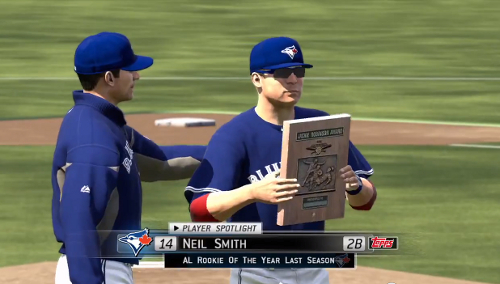
Review: MLB 13 The Show


PlayStation's MLB the Show series has been a major success, taking home sports game of the year award multiple times since its release in 2006. Back then, baseball video games included the 2K series, MVP baseball, The Bigs, and a series of games simply called MLB and whatever year it was. Since David Wright graced the cover of MLB 06 The Show, it's blown all competition out of the water to the point where today only 2K baseball is left and that is fading quickly. It's gotten to the point where if a gamer wants to play a baseball game, then he has to have a ps3 to play the Show (since it's ps3 exclusive.)

New Features
  • Revamped Road To The Show mode
  • Different camera angles in all game types
  • Beginner mode 
  • Halo tracker helps to see the ball at all times
  • Almost every single player's batting stance is 100% accurate
  • In franchise game mode's, each team has different tendencies as to how they will build their team.
  • Postseason Mode

Positives
There is so much to love about this new edition of The Show. Sports games have more of a predicament than say Halo or Crysis because they need to come out with virtually the same game every year but still make it appealing to fans to get the new edition. Sony and San Diego Studios certainly do not make it look hard with this series.

Two things hit me right away in the first game I played in this game: the player tendencies and the overall feel of the game. What they did with batting stances was absolutely perfect. For the longest time, atleast I've wanted all of the players in the game to have their own stance because I always imagined it propelling the game to a completely new level, and it did. The ways that the batter swings and what he does before the pitch is spot on to what he does in real life.

Another new feature is beginner mode. This enables new users to the game to get their feet wet, pirsay, and figure the game out before they start a franchise. The CPU feeds the batter fastballs until they get their timing down, and it also provides feedback based on what they're doing right and wrong. Another minor feature that's been added is the ball halo and tracker. This is a glowing yellow-ish light and a red tail trailing from the ball that make it easy to see at all times. This is especially handy in RTTS when you're running the bases and need to know where the ball is going.

Possibly the biggest upside to the 2013 edition of The Show is the improved Road To The Show. In this game mode, you can create your own player and rise up through the minors to the MLB and beyond. But in year's past it's been a struggle. Often times (for me atleast) I'd end up as a 27-year old player just making it to the majors but never getting enough playing time and eventually my chances of ever being successful fade away. In other words it was really hard to do well. But now it's a lot more playable with multiple difficulty levels and new features. One is when you're fielding instead of seeing the play as if it was an exhibition game, you directly behind your player running to the ball. This makes for a more realistic and fun way to play the usually boring part of defense. Another is the ability to look at the ball while you're running (press R1) and pick up your third base coach (L1.) This is MUCH appreciated as running the bases has been more difficult than it had to be in years past without being able to see the ball and the camera switching angles all the time. Also, it's possible to completely customize your player as well. From the shape of his face to his stance to the way he follows through on a home run, it's all there.

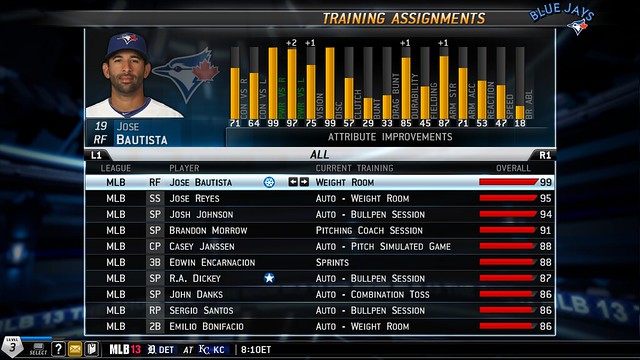
Postseason mode is a new element that's been added to the game too. It gives you the ability to play a postseason with any team and feel the excitement and roar of the crowd like a real playoff game would feel like. Also, in past games to view a player's overall, you had to look at a red bar and try to guess how muchout of 100 it is since there was never exact numbers. But realizing that every sports games now ranks players with overall numbers, The Show has given every attribute and overall a specific number which makes it a lot easier to asses who's actually better than who.

Negatives
There aren't too many drawbacks to point out, but every game has some. While the feel and pace of the game is spectacular overall, there are still a few glitches here and there. Every once in awhile I'll be batting and when the pitcher throws the ball, the game glitches out and I end up striking out embarrassingly  Or there's another instance where Diamondbacks center fielder Adam Eaton ended up running through the outfield wall and was trapped for the play. So while these occurrences rarely happen, it's still a little bit of a downside. 

Also, I was really hoping that every team would have an accurate farm system. And if that was too hard to do, which is understandable since the minor leagues consist of hundreds of players, atleast make the triple A teams accurate and have all of thetop 100 prospects in the game. But just as the first edition of The Show, the minor leagues are full of generically named players. Not even stolen base king Billy Hamilton or top prospect Travis D'Arnaud, whom RA Dickey was traded for. Overall it's not my biggest concern but it makes running a franchise a little less realistic.

Verdict (ratings out of ten)
  • Graphics: 8.5
  • Smoothness and overall feel: 9
  • Online gameplay: 7.5
  • Life of game (ability to play it for awhile): 8.8
  • Improvement over previous game: 8.5
  • Overall Rating: 8.9
MLB 13 The Show is definitely worth the purchase if you're a baseball fan. There's virtually no competition as far as other baseball games go, plus the graphics and way the game plays is far better than any other sports game. With the PS4 coming out later this year, there are many reasons to look forward to next year's edition of the game. But until then, The Show continues to provide stellar baseball gameplay.

The Money of the NCAA Tournament


All sorts of people make all sorts of money from the tournament. There are ads, sponsorships, ticket sales, wagers and more. But who gets the money, and how much?


1. Broadcast Rights
In 1982, CBS agreed to pay $16 million a year for the rights to broadcast the tournament. In 2010, the NCAA and CBS renewed that agreement for 14 years, but with an increased price tag: $771 million a year.  
CBS owns all the channels which broadcast the games (CBS, TNT, TBS, and TruTV).
For comparison, CBS, NBC, and FOX pay between $950 million and $1.1 billion for just the Super Bowl. CBS, NBC, and FOX will soon pay around $3.1 billion a year for the rights to the rest of the games, while ESPN will pay $1.9 billion. 
More comparison: FOX and Telemundo paid a total of $1 billion for the rights to the 2018 and 2022 World Cup. 

The money paid by CBS goes to the NCAA, where, according to their site, 96% of it is distributed to Division 1 schools in some fashion.

2. Advertising
While it's no Super Bowl, the tournament does get some pretty great ad rates, especially for the Championship. A :30 spot during the first round costs between $100,000 and $250,000 ($110,000 is average for network TV), while the same spot could cost more than $1.6 million during the championship. (For comparison, a :30 ad during the Super Bowl can cost more than $3.5 million.)

According to Adweek, a first or second round ad (again, :30) goes for $100-$250,000. By the time the Final Four hits, the price is up to $1.1 million, and the championship goes for the previously mentioned $1.6 million.

Last year's tournament brought in around $775 million in ad revenue for CBS. This year, that number is expected to rise to around $875 million.

Another interesting area related to advertising is ratings, which is the largest factor affected the price of an ad.
The incredibly worthless "First Four" games managed to get 4.48 million viewers this year (a pretty low rating when compared to network shows, which can get up to 15 million a week, but a pretty nice one when compared to cable shows, The Americans gets about 2 million a week and Breaking Bad and Mad Men get between 1 and 3 million.)
That 4.48 is up 14% from last years First Four.

Last year's tournament averaged 9.6 million viewers per game. The championship last year was watched by 20.1 million viewers.


3. Sponsorships and Ticket Sales
If you've seen any of the games, you've definitely experienced some of the sponsorships. AT&T got their mame slapped on every half time show, Capital One is sponsoring the Tournament Central studio show. (Coca-Cola is the third premium sponsor this year.)
While details are scarce on the numbers behind the sponsorships, it is estimated that Capital One pays $35 million their sponsorship. 

In previous years, ticket sales and sponsorships have made more than $40 million for the NCAA.  That number will likely be significantly larger this year. Again, 96% of this money is distributed to Division 1 schools. 

4. Wagers 
Chances are you filled out a braket. It's also pretty likely you entered this bracket in some sort of monetary award system, which requires an initial "investment" from you. Each year, an estimated 40 million brackets are filled out, and $7 billion is bet on these brackets. (That's more than the Super Bowl's $6 billion.)

Because of all this money on the line, employees have been known to focus less on work and more on sports. One survey estimatesthat 8.4 million hours of time are wasted during the tournament by private sector employees. Since the average pay is $22.87 an hour, that comes out to $192,108,000 in wages.
It is worth noting however, that this survey assumed that employees would otherwise be productive, which we all know is not always the case.

What's it All Mean?
So, unsurprisingly, a lot of money is made by people (mainly CBS and the NCAA) during March Madness. In total, about $1,693,000,000 is moved around by college basketball this month. With that you could buy 3.38 million iPads, 16,930,000,000 pieces of gum, or 483,714,285.714 gallons of gas, or enough to travel 11,609,142,857.1 miles in the US. 
You could also buy 7,695,454,545.45 meals for starving families in Africa. 
I leave it on that uplifting note. 


1909 Honus Wagner Baseball Card Could Auction for More than $3 Million


The rarest baseball card in the world in up for auction at the Audemars Piguet Flagship Boutique in midtown Manhattan. The 1909 "cigarette" card has reportedly already been bid on for $1.5 million and could go all the way up to $3 million. 

The card itself has its own display in the baseball hall of fame in Cooperstown, New York and is widely considered the most valuable baseball card of all time. "The Honus Wagner card is the Mona Lisa, the Van Gogh of our industry," said Ken Goldin, the founder of Goldin Auctions"You can be a casual baseball fan, but if there's one baseball card you've heard of — it's the Honus Wagner."

The last time a Wagner card was publicly sold was in 2012 for $1.2 million. Since then, the average Wagner card, depending on condition, has appreciated 70 percent in value.

The opening bid for the tiny piece of fine art was $500,000. Break open your piggy bank, the auction ends April 5.

The T206 Honus Wagner card was designed and issued between 1909 and 1911. But then Wagner refused to allow production of the card to continue either to prevent kids from buying cigarettes or because he wanted more compensation. It's estimated that there are anywhere from 60 to 200 of these cards worldwide.

The most famous T206 Honus Wagner is the "Gretzky T206 Honus Wagner" card. The card has a controversial past, as some speculate that it was once altered, based on the card's odd texture and shape. The Gretzky T206 Wagner was first sold by Alan Ray to a baseball memorabilia collector named Bill Mastro, who sold the card two years later to Jim Copeland for nearly four times the price he had originally paid. Copeland's sizable transaction revitalized interest in the sports memorabilia collection market. In 1991, Copeland sold the card to ice hockey figures Wayne Gretzky and Bruce McNall for $451,000. Gretzky resold the card four years later to Wal-Mart and Treat Entertainment for $500,000, for use as the top prize in a promotional contest. 
The next year, a Florida postal worker won the card and auctioned it at Christie's for $640,000 to collector Michael Gidwitz. In 2000, the card was sold via Robert Edward Auctions to card collector Brian Seigel for $1.27 million. In February 2007, Seigel sold the card privately to an anonymous collector for $2.35 million. Less than six months later, the card was sold to another anonymous collector for $2.8 million. In April 2011, that anonymous purchaser was revealed to be Ken Kendrick, owner of the Arizona Diamondbacks.[2] These transactions have made the Wagner card the most valuable baseball card in history.

Sunday, March 24, 2013

More Upsets, More History: FGCU First 15th Seed to Reach the Sweet 16


While it may not be the best thing for your tattered bracket, it's great for underdogs everywhere. 

The number 15 Florida Gulf Coast Eagles have solidified their placement as the lovable underdogs of 2013, as they defeated the No. 7 San Diego St. Aztecs, 81-71, and became the first 15 seed in tournament history to reach the Sweet 16.

The first half was pretty much even the whole time, with neither team pulling away. San Diego St. went into halftime up 35-34.

Just like that Georgetown game (where FGCU beat #2 Georgetown), the second half was much, much better for FGCU fans, and much, much worse for Aztec fans. 
The Eagles pulled off a 21-5 run to put the Aztecs away, and it was just as dazzling as the last game. San Diego St. gave up 17 turnovers on the game.

Bernard Thompson and Sherwood Brown led FGCU with 23 and 17 points, respectively. Brett Comer was a master on the point, dishing out 14 assists.

FGCU will play the #3 Florida Gators next week. 

Round Three Results

Let a Math Nerd Tell You Why Your Bracket Sucks, Even If You're Smart

Joey Votto Cranks a Homerun Off of Yu Darvish


Whether you're a Reds fan (like me) or not, this moonshot off of Darvish's curveball is so great that even Darvish is laughing about it.